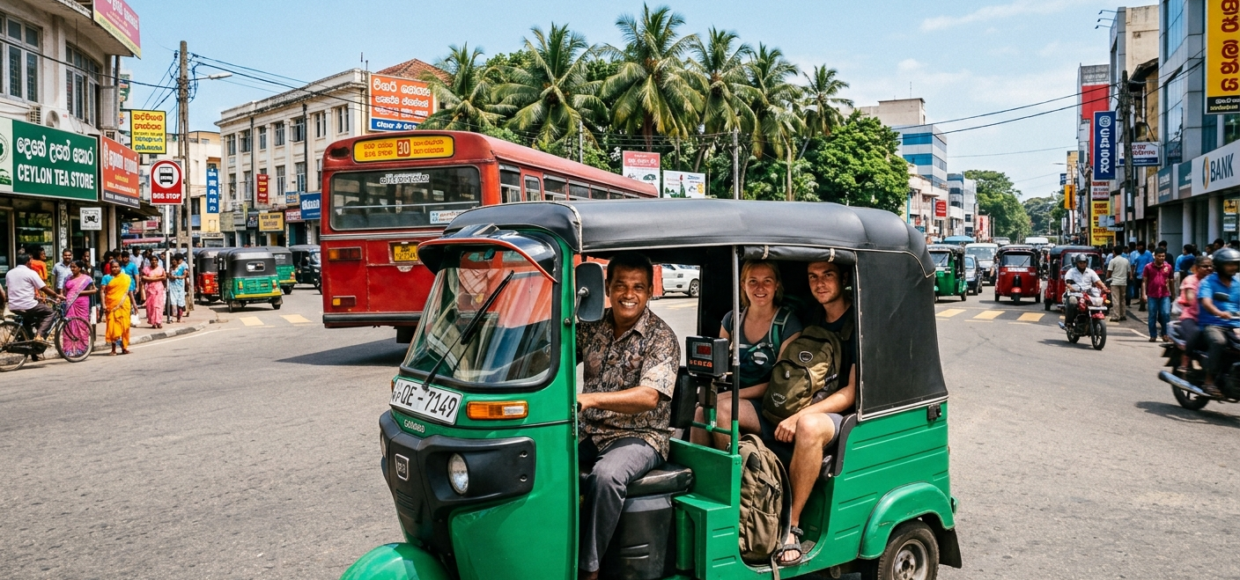

Sri Lanka Transportation: Tuk-Tuks and Buses Guide
Exploring Sri Lanka by tuk-tuk and public bus offers an authentic window into the heart of daily local life. Nevertheless, mastering the informal rules of these two iconic transport modes requires practical knowledge before setting off.
For this reason, we created this comprehensive guide to help you navigate mountain roads and bustling urban streets smoothly. Consequently, you will travel across the island with total peace of mind while keeping your holiday budget intact.
During our own travel itinerary across Sri Lanka, we relied continuously on these popular local vehicles. Therefore, we are sharing proven strategies to negotiate fares and avoid common travel pitfalls effortlessly.
Whether you need rapid door-to-door city transfers or authentic intercity journeys, these transit choices satisfy every need. As a result, you will optimize every single leg of your journey with remarkable overall efficiency.
Taking the time to understand local transport networks guarantees a seamless and culturally rewarding island adventure. Indeed, the real travel experience begins the moment you board alongside welcoming local commuters.
Furthermore, the sheer diversity of passing scenery turns every road trip into a mesmerizing panoramic sightseeing tour. For this reason, riding local transportation significantly enriches your overall cultural connection with Ceylon.
In fact, the vast majority of local residents depend on these vehicles daily to reach work or school destinations. Consequently, you will share genuine moments of human connection with local Sri Lankan families.
Finally, the sheer flexibility provided by these transit options allows you to modify travel plans at a moment’s notice. As a result, you will maintain total freedom throughout your entire tropical island expedition.
🛺 The Tuk-Tuk: Everyday Freedom and Flexibility
The three-wheeled tuk-tuk represents without question the most convenient transport option for short urban distances. Nevertheless, price negotiations can occasionally intimidate first-time visitors arriving in Sri Lanka.
Furthermore, understanding how digital meters and mobile booking apps work saves you from paying inflated tourist prices. For this reason, adopting smart transit habits right from the moment you exit the airport is essential.
In fact, these nimble three-wheelers navigate heavy urban traffic jams with astonishing agility and speed. Consequently, they drop you off directly at your hotel doorstep or right outside temple entrance gates.
As a result, you save precious time during busy sightseeing days spent exploring historic cultural sites. Therefore, the humble tuk-tuk quickly becomes your indispensable daily companion for short urban hops.
📱 Using Ride-Hailing Apps in Major Cities
In major urban centers like Colombo or Kandy, download the local ride-hailing app PickMe onto your phone immediately. In fact, this platform operates just like Uber and calculates fair, fixed rates per kilometer traveled.
Consequently, you no longer need to engage in lengthy price negotiations with drivers before climbing aboard. As a result, you enjoy complete price transparency with fares settled seamlessly via cash or credit card.
The Uber application also operates smoothly within the capital city for booking private three-wheeler rides. Indeed, utilizing these digital booking platforms effectively shields you from common overcharging tactics near train stations.
Furthermore, the upfront price displayed on your smartphone screen guarantees the driver follows the shortest GPS route. For this reason, purchasing a local prepaid SIM card upon arrival is strongly recommended.
Having reliable mobile data access simplifies ordering rides at any hour of the day or night. Furthermore, you can track your journey progress in real time using interactive digital maps on your device.
Indeed, drivers registered on ride-hailing platforms are clearly identified and tracked within the digital system. Consequently, you travel with heightened personal safety, particularly during late-night urban trips.
🤝 Negotiating Fares in Rural Destinations
In rural coastal towns or mountain villages, ride-hailing apps do not operate, making verbal negotiation necessary. In fact, always establish the total ride price clearly before sitting down on the rear passenger bench.
Consequently, feel free to politely counter initial quotes with lower offers if quotes seem unreasonably high. As a result, you will quickly reach a fair compromise that satisfies both the driver and your wallet.
Keep in mind that average short-distance rides in tourist areas generally cost only a few hundred Sri Lankan rupees. Indeed, always carry small cash denominations in your pockets to facilitate quick payments upon arrival.
Therefore, avoid handing large five-thousand rupee banknotes to tuk-tuk drivers for small ride fares. As a result, you prevent awkward situations where drivers claim they lack sufficient cash change to return to you.
Maintain a friendly smile and polite demeanor throughout all price discussions with local three-wheeler operators. Indeed, bargaining in Sri Lanka should always remain an enjoyable, respectful, and lighthearted social interaction.
Furthermore, asking guesthouse staff members about standard route rates provides valuable pricing benchmarks beforehand. For this reason, you will enter every price negotiation equipped with accurate local rate knowledge.
🗺️ Renting a Self-Drive Tuk-Tuk for the Island
An exciting trend gaining immense popularity among adventurous travelers is renting and driving a self-drive tuk-tuk. Indeed, steering your own vehicle across the island for several weeks delivers unmatched personal independence.
However, this self-drive adventure legally requires obtaining a temporary Sri Lankan driving permit from local authorities. Furthermore, specialized rental agencies handle all these required official administrative steps prior to your arrival date.
Book your vehicle through reputable providers like Tuktuk Rental to receive comprehensive driving lessons before departure. In fact, mastering the handlebar gear clutch system demands dedicated hands-on instruction from professionals.
Consequently, you will practice maneuvering through local traffic patterns under the watchful guidance of an experienced instructor. As a result, you will hit the open Sri Lankan highways with absolute mechanical confidence.
These specialized rental companies also provide comprehensive roadside assistance and full insurance coverage island-wide. Therefore, any minor mechanical issue gets resolved rapidly by a network of trusted local repair shops.
Consequently, you will drive into remote rural villages completely missed by conventional tourist bus itineraries. For this reason, self-drive rentals appeal powerfully to road-trip enthusiasts seeking authentic off-the-beaten-path discovery.
🚌 The Bus Network: Economical and Authentic
Public and private buses form the most extensive and affordable transportation network across all of Sri Lanka. Indeed, thousands of routes crisscross the country daily, connecting major coastal hubs to remote mountain villages.
Furthermore, riding the bus provides nonstop cultural entertainment accompanied by energetic local music and friendly passengers. For this reason, this immersive travel experience deeply appeals to independent travelers seeking authenticity.
In fact, you will be amazed by the sheer frequency of departures from major municipal bus stands island-wide. Consequently, simply arriving at a central bus station guarantees finding a departing vehicle heading toward your destination.
As a result, you never need to book short regional bus trips weeks in advance. Therefore, public buses fit flexible, spontaneous travel itineraries that adapt to changing weather or personal preferences.
🔴 Distinguishing Public and Private Buses
Public buses operated by the Sri Lanka Transport Board are easily recognized by their bright red paint jobs. In fact, they are exceptionally cheap to ride but lack air conditioning systems onboard.
Consequently, public red buses stop frequently along roadways to pick up or drop off local commuters. As a result, total travel times can stretch considerably over long, winding mountain journeys.
Conversely, private buses feature white exteriors decorated with vibrant religious artwork and colorful interior lights. Indeed, many private intercity coaches offer air-conditioned seating along major highway corridors for slightly higher fares.
Furthermore, air-conditioned express buses make far fewer en-route passenger stops than standard public vehicles. For this reason, booking intercity express seats on BusBooking Sri Lanka is ideal for long journeys.
Be aware that onboard air conditioning in private express buses is often set to freezing temperatures. Indeed, packing a lightweight sweater or scarf inside your daypack prevents getting uncomfortably cold during long rides.
Furthermore, ticket prices for private air-conditioned coaches remain remarkably inexpensive compared to Western transport standards. Consequently, you enjoy significantly elevated physical comfort for just a few extra dollars.
🎒 Managing Luggage and Onboard Comfort
Traveling on local buses with large backpacks requires smart physical organization when boarding crowded vehicles. In fact, you may need to place heavy luggage near the engine cover beside the driver.
Consequently, always keep small personal valuables, passports, and electronics inside a compact daypack on your lap. As a result, you maintain constant physical contact with your most important possessions throughout the journey.
Pack earplugs or noise-canceling headphones if you are sensitive to loud music or noisy road environments. Indeed, Sri Lankan bus drivers love playing vibrant local pop music over onboard speakers to stay energized.
Therefore, choose seats located toward the front of the vehicle to minimize motion sickness on winding roads. As a result, you will enjoy sweeping scenery through the windows while traveling in far greater physical comfort.
Never hesitate to ask friendly bus conductors for help when lifting heavy suitcases onto steep entrance steps. In fact, onboard transport crews are extraordinarily helpful toward international visitors navigating their bus network.
Furthermore, keep small cash notes easily accessible inside your pockets rather than digging deep into main bags. For this reason, traveling lightweight simplifies boarding and exiting crowded buses at busy transit stops.
🧭 Understanding Tickets and the Conductor’s Role
Onboard every bus, the conductor plays a crucial operational role managing passenger flow and collecting fares. In fact, conductors navigate packed central aisles with amazing balance while the vehicle sways in motion.
Consequently, simply state your destination town clearly when the conductor approaches your seat to receive a printed ticket. As a result, the payment process functions with complete transparency and ease for international travelers.
Ticket payments are made strictly in cash directly to the conductor during the first few kilometers of travel. Indeed, having exact change or small denomination notes ready makes the conductor’s job much easier.
Therefore, you help keep aisle movement flowing smoothly without causing unnecessary fare collection delays. For this reason, keeping small coins and hundred-rupee notes on hand is greatly appreciated by transport staff.
The conductor will also alert you when your specific drop-off stop is approaching along the highway route. Furthermore, they will whistle loudly to signal the driver to bring the bus to a complete stop for you.
Consequently, you never have to worry about missing your stop, even if you cannot read Sinhala signboards. As a result, place your confidence in the remarkable attentiveness of local Sri Lankan bus crews.
🛡️ Safety and Practical Road Tips
Traffic behavior in Sri Lanka often surprises Western travelers due to its fast-paced, highly assertive nature. Indeed, overtaking maneuvers happen constantly with frequent horn honking on narrow two-lane roadways.
Furthermore, following basic personal safety precautions ensures smooth travel without physical mishaps along the way. For this reason, remaining alert remains important whenever riding inside tuk-tuks or long-distance buses.
In fact, large buses always claim physical right-of-way over smaller vehicles like motorbikes and three-wheelers. Thus, understanding local road hierarchy helps you stay calm while navigating busy traffic corridors.
Consequently, observe road conditions attentively without letting unfamiliar driving styles cause unnecessary anxiety. As a result, you will naturally adapt to Sri Lanka’s unique transport rhythm after a few days.
⚠️ Smart Safety Habits Inside Tuk-Tuks
Always keep your arms, hands, and legs inside the vehicle frame when riding through congested city streets. In fact, passing buses and lorries frequently squeeze past three-wheelers with very narrow side clearances.
Consequently, place daypacks and shopping bags securely in the middle of the seat rather than near outer edges. As a result, you prevent bags from accidentally slipping out onto the roadway during sharp turns or sudden stops.
Never board a tuk-tuk if the driver appears visibly fatigued or under the influence of alcohol. Indeed, your personal physical safety must always take priority over convenience or speed when traveling abroad.
Therefore, prefer booking evening rides through verified hotel desks or official hotel listings on Booking.com. Consequently, you travel with vetted drivers recommended directly by established accommodation owners.
Check that the vehicle features sturdy metal handrails mounted on both sides of the passenger seat frame. Indeed, holding on tightly during sudden braking maneuvers prevents you from sliding forward inside the cabin.
Furthermore, politely ask your driver to slow down if you feel uncomfortable with their driving speed. For this reason, using simple, clear English phrases will communicate your speed preferences immediately.
⏳ Estimating Travel Times Accurately
Never calculate transit times based strictly on total kilometer distances shown on digital mapping applications. In fact, average driving speeds across Sri Lankan roads rarely exceed forty kilometers per hour due to heavy traffic.
Consequently, build generous buffer times into your itinerary when heading to airports or connecting train stations. As a result, you will avoid unnecessary travel stress caused by unexpected road delays or traffic jams.
Double-check bus departure times with local guesthouse hosts the evening before your planned regional journey. Indeed, official printed timetables change frequently, whereas local residents know exact real-time bus schedules.
Furthermore, schedule long journeys early in the morning to avoid traveling during the hottest afternoon hours. For this reason, departing at sunrise remains the single best strategy for cool, comfortable transit.
Winding mountain roads require twice as much travel time as modern flat coastal highways or expressways. In fact, traffic often slows significantly behind heavily loaded tea trucks navigating steep hairpin turns.
Consequently, factor these natural geography delays into your daily sightseeing schedules well in advance. As a result, you will approach every travel day relaxed, unhurried, and ready for adventure.
🌧️ Adapting to Weather and Monsoon Rains
Seasonal monsoon tropical downpours can flood low-lying roadways rapidly, slowing regional traffic movement significantly. Indeed, driving conditions for both tuk-tuks and buses demand extra care during heavy rainstorms.
For this reason, tuk-tuk drivers roll down thick waterproof plastic side curtains to protect passengers from rain. Furthermore, verify that these side covers are securely snapped into place before heavy downpours begin.
Bus drivers also reduce road speeds significantly during severe rains to prevent hydroplaning on slick asphalt surfaces. In fact, noticeable schedule delays should be expected when traveling through coastal regions during monsoon months.
Consequently, maintain schedule flexibility if sudden tropical weather systems disrupt planned afternoon travel legs. As a result, you will avoid traveling unsafely during severe weather episodes.
Pack valuable electronics, cameras, and travel documents inside waterproof dry bags before setting off. Indeed, heavy tropical rainwater spray can penetrate open vehicle cabins quickly during driving windstorms.
Therefore, preparing for tropical weather guarantees comfortable, stress-free transit regardless of changing forecasts. For this reason, well-prepared travelers enjoy their journey across Sri Lanka in any season.
📖 Personal Experiences on Sri Lankan Roads
During our journey through the hill country between Ella and Nuwara Eliya, we traveled by local public bus. Indeed, the sweeping mountain tea plantation views visible through the open windows were utterly breathtaking.
Furthermore, we struck up a conversation with a friendly local family who shared homemade snacks with us. For this reason, what started as a simple transit leg turned into an unforgettable highlight of our trip.
In fact, we initially felt slightly nervous about the driver’s brisk pace along narrow mountain passes. However, observing the driver’s complete skill and calm control quickly put all our worries to rest.
Consequently, we let go of our initial anxiety and embraced the lively music playing through the cabin speakers. As a result, we immersed ourselves fully in the joyful rhythm of daily Sri Lankan life.
🚕 Daily City Adventures in Tuk-Tuks
For our everyday urban trips around Kandy, we relied heavily on the PickMe mobile application with great success. In fact, booked drivers consistently arrived at our guesthouse doorstep in under three minutes.
Consequently, we completely avoided lengthy price bargaining under the scorching afternoon tropical sun. As a result, we maximized our daily temple visits with unprecedented ease and scheduling efficiency.
One evening, a friendly tuk-tuk driver recommended a hidden local eatery completely absent from popular guidebooks. Indeed, we enjoyed the most delicious and authentic rice and curry feast of our entire month-long journey.
Furthermore, this spontaneous encounter highlighted the extraordinary warmth and hospitality characteristic of local drivers. For this reason, riding three-wheelers delivers rich cultural interactions that extend far beyond simple transportation.
In summary, combining public buses for long trips with tuk-tuks for short hops made travel delightfully affordable. In fact, the total independence experienced navigating Sri Lanka’s roads remains an absolute highlight of our trip.
Consequently, we strongly encourage every traveler to embrace local transport options from day one. As a result, you will experience a deeply authentic, memorable journey connected directly with the island’s wonderful people.
❓ Frequently Asked Questions About Sri Lankan Transit
🔑 Can foreigners rent and drive a tuk-tuk independently in Sri Lanka?
It is entirely possible for foreign travelers to rent and drive a tuk-tuk across the entire island. Indeed, this popular self-drive option provides complete independence to explore off-the-beaten-path locations at your own pace.
However, you must legally possess a temporary Sri Lankan driving permit issued by the Automobile Association of Ceylon. For this reason, your chosen rental agency will usually process these required legal documents prior to arrival.
Take time to complete a thorough two-hour driving lesson offered by rental agencies before setting out independently. In fact, operating a manual handlebar gear system requires proper mechanical practice under expert supervision.
Consequently, you will master handling the vehicle safely before driving into busy public traffic corridors. Furthermore, ensure that your rental agreement includes comprehensive third-party insurance coverage across all regions.
Driving your own three-wheeler demands constant awareness regarding large passing buses along narrow rural roads. Furthermore, lightly tapping your horn on blind mountain curves alerts oncoming traffic to your presence.
Consequently, you will adapt to local driving etiquette smoothly while exploring the island at your leisure. As a result, self-driving delivers an unforgettable road-trip adventure filled with unique personal discoveries.
🎟️ How do you buy and pay for bus tickets in Sri Lanka?
You do not need to purchase bus tickets in advance for regular public or private regional bus routes. Indeed, simply board the vehicle at any designated bus stand and find an available seat.
Once the bus is underway, the conductor moves down the central aisle collecting fares from newly boarded passengers. For this reason, simply state your final destination clearly so the conductor calculates your exact ticket price.
The conductor issues a printed paper receipt indicating the exact fare charged for your specific route length. In fact, bus fares are heavily regulated by the government and cost remarkably little even for multi-hour trips.
Consequently, keep this paper ticket handy until you reach your final destination for potential ticket inspections. As a result, buying bus tickets onboard is exceptionally straightforward for international tourists.
If the bus is completely full upon boarding, you may need to stand briefly until seats open up. Indeed, local passengers naturally make room for newcomers as fellow travelers exit at upcoming village stops.
Therefore, keeping small cash notes ready in your pocket speeds up fare collection for busy conductors. For this reason, simple cash transactions keep Sri Lanka’s public transit system moving with impressive speed.
🧳 Do Sri Lankan buses accept large suitcases and backpacks?
Sri Lankan buses accommodate foreign luggage, though storage space onboard smaller public buses can be quite limited. Indeed, exterior luggage compartments are rarely present on standard red public transit vehicles.
Consequently, you will often place large backpacks near the driver on the front engine cover compartment. For this reason, conductors may occasionally request a half-fare ticket payment to cover the occupied seat space.
Opting for soft backpacks rather than rigid hard-shell suitcases makes fitting luggage into overhead racks much easier. In fact, flexible bags squeeze far more easily into narrow interior storage racks above passenger seats.
As a result, you travel comfortably without blocking the central aisle reserved for boarding and exiting commuters. Therefore, packing thoughtfully ensures hassle-free transfers regardless of vehicle size or crowd density.
Additionally, attach clear luggage identification tags featuring your phone number to every piece of baggage you carry. Indeed, this prevents accidental bag mix-ups when multiple travelers stack similar backpacks near the front engine.
Furthermore, keep valuable items, passports, and electronics inside a compact daypack carried directly on your lap. For this reason, smart luggage management guarantees worry-free transit across Sri Lanka’s bus network.
🌙 Is it safe to ride tuk-tuks late at night in Sri Lanka?
Taking a tuk-tuk late at night is generally very safe across major Sri Lankan towns and tourist areas. Indeed, local residents are exceptionally welcoming, helpful, and respectful toward international visitors traveling at night.
However, booking late-night rides through mobile applications like PickMe or Uber adds an extra layer of security. For this reason, you enjoy live GPS tracking of your route directly on your smartphone screen.
If hailing a three-wheeler on the street late at night, establish the agreed fare clearly before getting inside. In fact, avoid traveling alone late at night if you have been consuming alcohol at local beach bars.
Consequently, ask your hotel or restaurant staff to call a trusted local driver to take you home safely. As a result, you will end evening outings comfortably with reliable, secure local transport.
Confirm that your driver knows the exact address of your accommodation before departing into unfamiliar neighborhoods at night. Indeed, small guesthouses tucked away down unlit side lanes can be tricky to locate after dark.
Therefore, carrying a hotel business card printed with address directions in Sinhala ensures a smooth journey home. For this reason, simple preparations guarantee complete safety during late-night urban travel.
💸 What are the average prices for daily tuk-tuk and bus rides?
Transportation costs in Sri Lanka remain among the most affordable anywhere in the entire Asian region. Indeed, a typical ten-minute urban tuk-tuk ride rarely exceeds the equivalent of two or three US dollars.
Furthermore, traveling for several hours across the countryside on a public bus costs just two to four dollars. For this reason, relying on public transit idealizes low-budget travel for budget-conscious backpackers.
For tuk-tuks booked via ride-hailing apps, base flag-fall rates start at roughly fifty Sri Lankan rupees. In fact, rates increase incrementally per kilometer at transparent, fixed prices monitored directly by the app.
Consequently, you can easily calculate your daily transportation budget before leaving your hotel room each morning. As a result, managing travel expenses across Sri Lanka becomes effortlessly predictable and stress-free.
Asking guesthouse hosts for typical route fares prevents overpaying in areas where ride-hailing apps are unavailable. Indeed, local price knowledge empowers you to negotiate fair prices confidently with independent drivers.
Therefore, utilizing buses and three-wheelers keeps daily travel expenses exceptionally low throughout your tropical vacation. For this reason, these transportation savings allow you to spend more on experiences, tours, and food.