🎣 Sri Lanka’s Famous Stilt Fishermen: Between Authentic Tradition and Tourist Trap
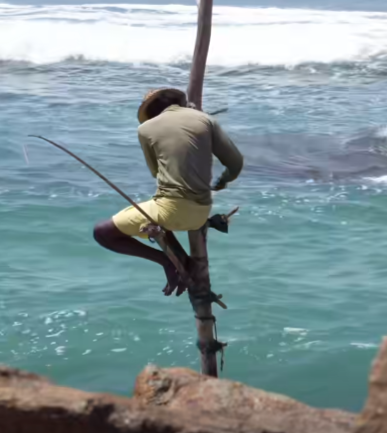
When planning a trip to Sri Lanka, certain images immediately come to mind. Beaches lined with coconut palms, Buddhist temples, trains winding through the mountains, and wild elephants are among the island’s most iconic sights. But one image in particular catches the eye: that of the famous fishermen perched on tall stilts above the ocean. Their silhouettes seem to perfectly capture the authenticity of Sri Lanka. Yet behind this photograph, now a staple on Instagram, the reality deserves some explanation.
Stilt fishing does indeed exist in Sri Lanka and has a rich history along the country’s southern coast. However, the growth of tourism has gradually transformed this tradition. In some heavily visited areas, the people you see sitting on the stilts now work primarily for tourists. They may climb up to their perches when a group arrives, strike a pose, and ask for payment in exchange for photos. This situation does not mean the entire tradition is artificial, but it does show just how much tourism has altered this practice.
🌴 A Genuine Tradition of Sri Lanka’s Southern Coast
Stilt fishing is a unique technique associated with several areas along Sri Lanka’s southern coast. It is found particularly around Koggala, Ahangama, Midigama, and Weligama. The method involves driving a long pole directly into shallow water, then using a small crossbar that allows the fisherman to sit above the water. From this position, the fisherman can use a line to try to catch fish. This method requires balance and some experience, especially when the waves and currents become stronger.
Contrary to some publications that portray this practice as a centuries-old tradition, its history is more recent. Historical sources trace its development to the mid-20th century, particularly during the difficult years of World War II. Coastal communities at that time developed various solutions to continue fishing despite economic hardships and local constraints. In particular, the stilts made it possible to fish in certain shallow areas without needing a large boat.
🎣 Why Has This Image Become So Famous?
Fishing on stilts has all the makings of a spectacular photograph. A lone man appears to float above the ocean, perched on an extremely slender structure, with the horizon behind him. As the sun begins to set, the light completely transforms the scene and creates a particularly photogenic silhouette. The colors of the sky, the reflections on the water, and the nearby coconut palms further enhance this impression. It is therefore no surprise that this image quickly became one of Sri Lanka’s most recognizable tourist symbols.
Travel magazines, guidebooks, and social media have greatly contributed to this popularity. Instagram, in particular, has amplified the phenomenon by sharing thousands of photographs taken at sunset. Travelers then sought to recreate exactly the same images during their own stays. This demand has created a new economy centered around the stilts. In some areas, the fisherman is no longer just someone practicing a traditional activity. He has also become a key part of a tourist experience sought after by visitors.
📸 Are the Fishermen Actually Fishing?
This is probably the question many travelers ask themselves when they first arrive on the south coast. The answer is not simply yes or no. Some fishermen still actually engage in this activity, while others mainly climb onto the stilts when tourists arrive. In some places, the men even wait near the water’s edge and head up to their perches when they see visitors pulling over. They may then stay for a few minutes to let tourists take their photos.
This situation may come as a surprise when one expects to witness a completely spontaneous scene. However, it is important to understand that tourism is now a major source of income for many communities along the south coast. A person may therefore engage in traditional fishing at certain times and agree to pose for tourists at other times. The line between traditional activity, cultural demonstration, and tourist attraction thus becomes quite difficult to define. It is therefore better to consider each situation with nuance rather than automatically assuming that a scene is staged.
💰 Why Do You Sometimes Have to Pay to Take a Photo?
When you arrive near certain busy stilt fishing locations, someone may ask you to pay to photograph the fishermen. This situation may seem surprising, especially when the landscape appears accessible to everyone. However, this payment often compensates the fisherman for the time spent with visitors. A fisherman who climbs onto his stilt for several groups of tourists may spend part of his day giving demonstrations rather than focusing exclusively on his traditional craft. Tourism thus directly creates an additional source of income.
The amount requested may vary depending on the location, the situation, and what you wish to do. In some cases, you simply pay to photograph the person from the beach. In others, the fisherman may offer to pose for a longer time or allow the visitor to get closer to the stilt. The best approach is to ask the price before you begin. This way, you will avoid misunderstandings and know exactly what the terms are for taking your photos. This simple precaution generally makes the experience much more enjoyable for everyone.
🌅 When Is the Best Time to See Them?
If you want to photograph the fishermen on stilts, the end of the day often offers the most spectacular conditions. The sun gradually sinks toward the horizon, casting a golden light that really brings out the silhouettes. Photographers particularly love this time of day for creating backlit images of the fishermen. Early morning can also be a good time, especially if you prefer a calmer atmosphere and softer light. In any case, conditions depend heavily on the weather and the season.
However, it is important to distinguish between the best time to take a beautiful photograph and the best time to observe actual fishing activity. The most frequently photographed scenes at sunset can be particularly crowded with tourists. If your main goal is to understand this tradition, ask the locals or your lodging provider for information instead. They can sometimes tell you the times when certain fishermen are actually working. This approach requires a little more preparation, but it can greatly enhance your experience.
📍 Where Can You See the Famous Stilt Fishermen?
The south coast is the region best known for this practice. The areas of Koggala, Kathaluwa, Ahangama, Midigama, and Weligama regularly feature in itineraries dedicated to stilt fishermen. Weligama, in particular, serves as a convenient base for travelers wishing to explore this part of the coastline. The town has a long beach and also offers easy access to other activities such as surfing, local restaurants, and day trips to nearby towns. You can therefore easily incorporate this experience into a broader itinerary.
Koggala is also an interesting area to discover this tradition. The region is located near several other attractions on the south coast, making it possible to plan a fairly full day. For example, you can combine watching the fishermen with a visit to Galle, a trip on the Madu River, or a tour of various coastal villages. This approach avoids spending several hours solely on photography. Above all, it allows you to discover various facets of southern Sri Lanka in a single day.
🏨 Where to Stay to Easily Explore the Fishermen’s Villages?
If you would like to spend several days on the southern coast, Weligama is a particularly convenient base. The town makes it easy to enjoy the beach while staying close to several areas associated with the stilt fishermen. Ahangama is also an attractive option for travelers seeking a vibe more focused on beaches, surfing, and small restaurants. Galle may be a better fit for those who want to combine historical sites, dining, and day trips to the various southern beaches.
Your choice of accommodation will therefore depend mainly on your itinerary. Before booking, carefully check the location of the property and its distance from the places you want to visit. A slightly cheaper hotel that is very far away may end up costing you more in transportation and wasting a lot of your time. To compare available accommodations in the region, you can explore the different options based on your travel dates and budget.
🏨 View available hotels and accommodations in Weligama
🚗 Can This Attraction Be Included in a Tour?
Yes, and this option can be particularly appealing if you are short on time. Several organized tours in southern Sri Lanka allow you to combine different attractions in a single day. This way, you can experience the stilt fishermen while visiting Galle, certain beaches along the southern coast, or other cultural sites. This option saves you from having to organize all the transportation yourself and often allows you to benefit from the insights of a local guide or driver.
A tour can also help you understand stilt fishing within its regional context. Instead of just stopping for a few minutes to take a photo, you can explore several locations and gain a better understanding of the environment in which this tradition developed. Itineraries vary by tour operator and date, so it is important to check the exact details before booking. If this option fits your itinerary, you can explore the activities available in the region.
🎟️ Discover a tour of the south coast featuring Galle and the fishermen
🤔 How Can You Tell If a Scene Is Very Touristy?
There are several clues that can help you quickly assess the situation when you arrive at a beach. If several people are waiting near the stilts and only climb up when visitors arrive, you are likely looking at a staged performance for tourists. You may also notice that the fishermen remain motionless and strike a particularly photogenic pose while several people take their pictures. This behavior does not necessarily mean the person has never actually fished, but it does show that the scene now caters to tourist demand.
Conversely, someone already settled on a stilt, busy handling their line and watching the water without paying attention to visitors, is more likely to be engaged in genuine fishing. However, this observation should not be taken as an absolute rule. A fisherman may very well be fishing and then agree to pose for a few photographs afterward. The situation also varies depending on the season, weather conditions, and local economic needs. That is why it is better to observe and ask a few questions rather than jump to a conclusion.
🌊 Does This Tradition Really Still Exist?
Yes, stilt fishing has not completely disappeared. Some people continue to practice this method, and some families wish to preserve this part of their coastal heritage. In some areas, tourism has even helped maintain the stilts and preserve a practice that might otherwise have gradually disappeared. However, the economic role of this activity has changed. Income from visitors can now account for a significant portion of what some people earn from the stilts.
It would therefore be unfair to say that all the fishermen visible on the beaches are merely extras. The reality is much more complex. Some actually fish, others primarily put on tourist demonstrations, and some combine both activities. Above all, this evolution shows how a local tradition can adapt to the massive influx of visitors. When you watch the stilt fishermen, you are witnessing both a cultural practice and an activity that has been profoundly influenced by international tourism.
📱 Why Does Instagram Give a Different Impression?
Social media rarely shows the full scope of a tourist experience. An Instagram photo typically captures the most visually appealing moment: a lone fisherman, a perfectly calm sea, and a magnificent sunset. You usually do not see the cars parked behind the photographer, the other tourists on the beach, or the people waiting their turn. You only get to see a few carefully chosen seconds from a much longer and sometimes much more touristy experience.
This selection therefore creates an impression of isolation and authenticity that does not always match the reality on the ground. When you arrive, you may find several groups of visitors, photographers, and fishermen who know exactly why tourists come. That does not mean the place is not worth visiting. You simply need to go in with the right expectations. You will enjoy the experience more if you know that part of the scene may have been tailored for tourism.
✨ How Can You Have a More Authentic Experience?
The best approach is to plan your visit before you leave. Do not automatically choose a place just because an Instagram photo impressed you. Try to find out where the fishing communities are located and ask locals or your lodging provider for information. Local drivers and guides sometimes know areas that are less crowded than the most popular stops. A little extra information can completely transform your experience and help you discover a different side of southern Sri Lanka.
You can also adopt a respectful approach once you arrive. Ask for permission before taking photos and inquire about any fees that may apply. If a fisherman agrees to pose for you in exchange for payment, you can view this payment as a tourist service rather than a scam. That way, you know exactly what you are paying for and are directly contributing to a local person’s income. This transparency allows you to enjoy the experience without causing misunderstandings.
📖 Why Plan Your Trip Before You Go?
Sri Lanka offers a wealth of experiences that are not always included in standard itineraries. The most famous sites may sometimes live up to their reputation, but they represent only a small fraction of what the island has to offer. The fishermen on stilts are a perfect example of this. You can stop for a few minutes to take a great photo or take the time to learn about the history of this tradition and meet the people who still keep it alive.
This is precisely why doing a little research before you go can make a big difference. By knowing the locations, schedules, and local customs, you can avoid disappointment and better organize your days. You can also spend more time at places that truly meet your expectations. A few local tips can transform a simple tourist stop into a true cultural discovery and help you experience southern Sri Lanka in a more meaningful way.
In our ebook dedicated to Sri Lanka, we share the places and experiences we genuinely recommend, as well as lesser-known spots, local contacts, and practical advice for planning your trip. Our goal is to help you distinguish between a must-see attraction, an interesting experience, and a place that has become primarily touristy. This way, you can create a more cohesive itinerary and avoid wasting time during your trip.
🧭 Should You Still Go See the Stilt Fishermen?
Yes, without a doubt. Even though some scenes are geared toward tourists, the fishermen on stilts represent a fascinating part of the recent history of Sri Lanka’s southern coast. The stilts, the technique used, and the coastal landscape offer insight into how local communities developed their own way of working with marine resources. Tourism has since added a new economic dimension to this practice. Observing this evolution is precisely what makes the experience so interesting.
The most important thing is simply to know what you are actually hoping to discover. If you are only looking for a spectacular photo, you will likely find a suitable spot quickly. If you are seeking an authentic cultural experience, take more time to talk to people, observe, and ask questions. You may then meet people who still actively engage in this activity and understand how tourism affects their daily lives. The difference between the two experiences can be significant, even if they sometimes take place just a few kilometers apart.
🌅 A Magnificent Photograph, but an Even More Interesting Story
Stilt fishermen remain one of Sri Lanka’s most fascinating sights. Their silhouettes above the ocean seem to tell an ancient, unchanging story, while the reality tells a much more complex tale. The practice does indeed exist, but tourism has profoundly transformed it. In some places, the people on the stilts work primarily for visitors, while others continue to practice this method as part of their traditional livelihood.
This reality does not make the visit any less interesting. On the contrary, it allows you to discover another facet of tourism in Sri Lanka and understand how a tradition can evolve in the face of international demand. So when you arrive on the south coast, take a few minutes to observe before you take out your camera. Ask for permission, learn about local customs, and accept that reality does not always look exactly like the photos you have seen on Instagram.
You will then discover something far more interesting than a simple image meant for social media: a Sri Lankan tradition that continues to evolve at the intersection of local heritage, economic activity, and international tourism. And if you would like to explore further, our Sri Lanka ebook is here to guide you with handpicked destinations, experiences we genuinely recommend, useful contacts, and practical tips. A little useful information before you leave can make all the difference between a typical tourist stop and a truly memorable travel experience.
🎣 Things to Keep in Mind Before Your Visit
✔️ Stilt fishing is a genuine tradition along Sri Lanka’s southern coast. It has a rich local history and continues to be practiced in certain communities.
✔️ Some of these scenes are now primarily staged for tourists. Fishermen may climb onto the stilts when visitors arrive so they can take photos.
✔️ A fee may be charged. Always ask the price before taking photos to avoid unpleasant surprises.
✔️ Koggala, Ahangama, Midigama, and Weligama are among the best-known areas. You can easily incorporate this experience into an itinerary focused on the southern coast.
✔️ Do not rely solely on Instagram. Photographs can give the impression of seclusion and authenticity that does not always match the reality on the ground.
✔️ Do some research before you go. Local advice can help you discover less-visited spots and gain a better understanding of the traditions.