
Paying in Sri Lanka: Budget, Cash, and Cards
Managing your money for a trip to Sri Lanka requires good preparation. However, financial transactions remain quite simple on the island.
For this reason, you should understand local payment habits clearly. As a result, you will avoid many unexpected financial surprises easily.
During our own travel itinerary in Sri Lanka, we noticed the great importance of cash. Indeed, cash remains king across the entire county.
Therefore, keeping local currency on you at all times is essential. In addition, cash makes your daily purchases much easier.
Thus, anticipating your foreign currency needs prevents searching for ATMs. For this reason, read our practical money advice carefully.
Furthermore, bank fees can add up quickly without proper care. Consequently, using the right payment card is extremely important.
Finally, we will cover daily budget details for every travel style. Indeed, travel costs have evolved recently on the island.
Therefore, follow our practical recommendations to handle expenses smoothly. As a result, you will enjoy your holiday stress-free.
💶 The Local Currency: Sri Lankan Rupee (LKR)
The official currency of the island is the Sri Lankan Rupee. However, its exchange value can fluctuate over time.
For this reason, check current exchange rates before your departure date. Indeed, knowing rates helps you calculate daily expenses accurately.
Generally, one US dollar or euro equals several hundred rupees. Consequently, you will quickly handle large banknote values daily.
In addition, local currency is usually written using the symbol LKR. As a result, you will see this code on price tags everywhere.
Furthermore, getting Sri Lankan rupees outside the country is impossible. Therefore, you must exchange money after landing on the island.
Finally, keep all your official currency exchange receipts safely. Indeed, receipts are required to convert leftover cash at airport departure.
💵 Banknotes and Daily Cash Management
Local banknotes range from 20 rupees up to 5,000 rupees. However, large bills are difficult to spend in small shops.
In fact, local vendors rarely have enough change for big notes. Therefore, set aside your smaller bills whenever possible.
For this reason, spend 5,000 LKR notes at large supermarkets instead. Furthermore, use large notes to settle your hotel bills easily.
As a result, you keep 100 and 500 LKR notes ready. Indeed, these small bills are vital for paying tuk-tuk drivers.
In addition, carry your daily cash inside a discreet pouch. Consequently, keeping money separated stays a very smart habit.
Finally, check banknote condition whenever receiving change back. Indeed, torn or damaged notes are often rejected by shopkeepers.
💳 Using Credit Cards in Sri Lanka
Credit cards are widely accepted at large tourist establishments. However, cards remain useless at small local family shops.
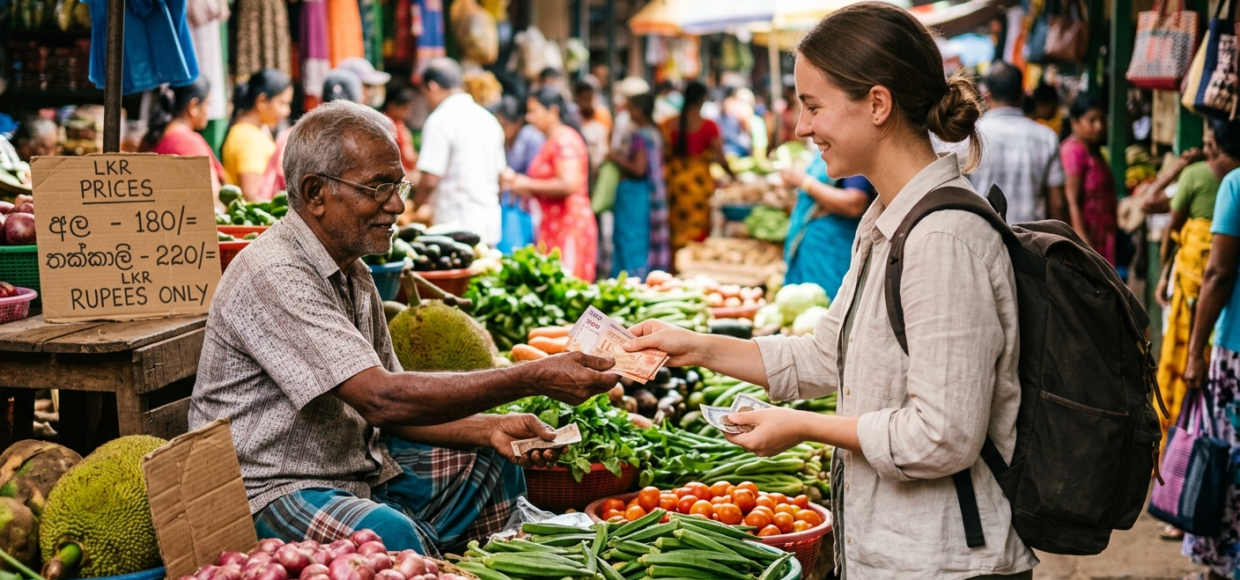
Consequently, you cannot pay for street food using a card. In addition, local fruit sellers accept cash payments only.
However, mid-range hotels usually welcome major international payment cards. As a result, you reduce the total cash you carry daily.
Furthermore, watch out for additional payment processing fees. Indeed, some merchant shops add a 3% surcharge for cards.
For this reason, always ask about extra fees before paying. Consequently, checking your final bill total remains very necessary.
🏧 Withdrawing Cash from ATMs
Automatic teller machines are abundant across all major towns. However, ATMs become much rarer inside rural countryside regions.
Therefore, withdraw sufficient cash before traveling into remote areas. In addition, prefer ATMs owned by major national banks.
Indeed, Bank of Ceylon and Commercial Bank are very reliable choices. Consequently, we recommend these trusted bank branches to travelers.
However, every cash withdrawal incurs a fixed local bank fee. Furthermore, your home bank may charge additional foreign conversion fees.
For this reason, make larger cash withdrawals less frequently. As a result, you minimize total transaction fees on your trip.
Finally, inform your bank about your travel plans before leaving home. Indeed, advance notice prevents unexpected card blocks while abroad.
🌐 Best Payment Cards for International Travel
Traditional debit cards often apply heavy foreign transaction fees. However, modern travel card options offer much better terms today.
In fact, digital banks provide minimal currency conversion rates online. Consequently, digital cards work perfectly for international travel needs.
For example, using a Revolut card helps save money on every payment. Moreover, the mobile app tracks expenses in real time.
Similarly, Wise cards offer excellent mid-market exchange rates daily. Therefore, many international backpackers choose these smart card options.
In addition, travel with two different bank cards in your bag. As a result, you keep a backup payment method if lost.
📊 What Budget Should You Plan for Sri Lanka?
Living costs have increased across the island in recent years. However, Sri Lanka remains an affordable destination for international tourists.
Indeed, your daily budget depends mainly on your travel style. Consequently, setting clear priority choices helps manage expenses well.
For this reason, we divided typical travel budgets into three tiers. As a result, you can estimate future total costs easily.
Furthermore, using local public transport saves a huge amount of cash. Therefore, combining transport options is a very smart approach.
🎒 Budget Travel / Backpacking
Budget travelers spend around $25 to $35 USD per day. However, this means staying inside simple local family guesthouses.
Indeed, homestays are very economical and offer warm local hospitality. In addition, you will eat meals at local roadside eateries.
For example, a traditional rice and curry plate costs very little. Consequently, daily food costs will not strain your travel budget.
Furthermore, travel using local public buses and scenic train routes. Therefore, living like locals remains the best budget strategy.
Finally, limit expensive tourist activities like private wildlife safaris. As a result, you maintain total control over daily finances.
🏨 Mid-Range Comfort Travel
For mid-range comfort, budget between $50 and $100 USD daily. Indeed, this tier provides great accommodation and comfortable travel options.
As a result, you stay in pleasant boutique hotels daily. Furthermore, these properties frequently feature lovely outdoor swimming pools.
In addition, you can mix local dining with Western-style tourist restaurants. Consequently, enjoying diverse meals becomes very easy every day.
Moreover, take tuk-tuks for short trips around town conveniently. Therefore, this travel style grants great freedom throughout your journey.
Finally, this budget covers most popular historical site entrance fees. As a result, you see iconic sights without financial stress.
🚗 Luxury Travel and Private Drivers
High-end luxury travel usually exceeds $120 USD per day per person. Indeed, this price range includes exclusive premium services throughout.
As a result, you tour the island inside a comfortable private car. Furthermore, a dedicated driver simplifies daily transit between sights.
In addition, sleep inside gorgeous luxury resorts and heritage hotels. Consequently, your nights stay peaceful, relaxing, and very comfortable.
For this reason, private drivers suit family travel exceptionally well. Moreover, private transport guarantees total peace of mind every day.
💡 Tipping Etiquette and Bargaining Rules
Tipping is a widespread custom across the tourism industry here. However, tips should always match the quality of service provided.
Indeed, leaving small gratuities directly supports hard-working local staff. In addition, tips are always received with genuine gratitude.
For example, leave a 10% tip at sit-down restaurants. As a result, you thank your waiter for good meal service.
Similarly, tip hotel luggage porters small amounts for assistance. Furthermore, plan a reasonable daily tip for your private driver.
However, agree on tuk-tuk prices before getting into the vehicle. For this reason, settle final fares before your ride starts.
Thus, you avoid uncomfortable price discussions upon reaching destinations. In conclusion, managing money in Sri Lanka becomes very simple.