
🦁 Visit Sigiriya and Dambulla: Complete Guide, Tickets, and Hotels 🏯
 "VisiterSigiriyaetDambulla Préparer son voyage au Sri Lanka")
Sri Lanka’s Cultural Triangle houses priceless archaeological treasures. Among these wonders, the spectacular fortress of Sigiriya and the shrine complex of Dambulla immediately captivate the imagination of travelers. These two major sites, inscribed as UNESCO World Heritage, are located just twenty-five kilometers apart. Consequently, you can very easily combine their exploration during an unforgettable step in your journey. On one side, a bold royal citadel overlooks an endless lush jungle. On the other side, five mystical caves enclose hundreds of Buddhist sculptures and two-millennium-old frescoes. If you are preparing a complete circuit across the island, do not hesitate to consult our practical Sri Lanka guide to organize your travel and excursion days.
This exhaustive guide gathers all the essential information to fully succeed in your trip. You will find precise details on the fascinating history of the monuments, official ticket prices in 2026, top accommodations, transport options, and a day-by-day itinerary. Follow our insider advice to optimize your budget and experience a memorable adventure in historic Ceylon.
🏛️ Why visit Sigiriya and Dambulla during the same trip? 🌿
First, the exceptional geographic proximity between these two cities makes them a perfect duo. Indeed, a short thirty-minute ride by car or tuk-tuk separates the center of Dambulla from the peaceful village of Sigiriya. You thus avoid multiplying long exhausting trips. You devote the core of your time on site to wonder and cultural discovery.
Second, these two attractions offer a striking architectural and spiritual complementarity. Sigiriya embodies temporal power, military genius, landscape art, and the fifth-century grandiosity. In contrast, Dambulla symbolizes religious devotion, monastic peace, and the continuity of Buddhism through the ages. Thus, you pass from the dazzling light of an aerial fortress to the hushed, mystical atmosphere of sanctuaries carved into the rock.
🦁 Lion Rock of Sigiriya: History, climb, and wonders 🌄
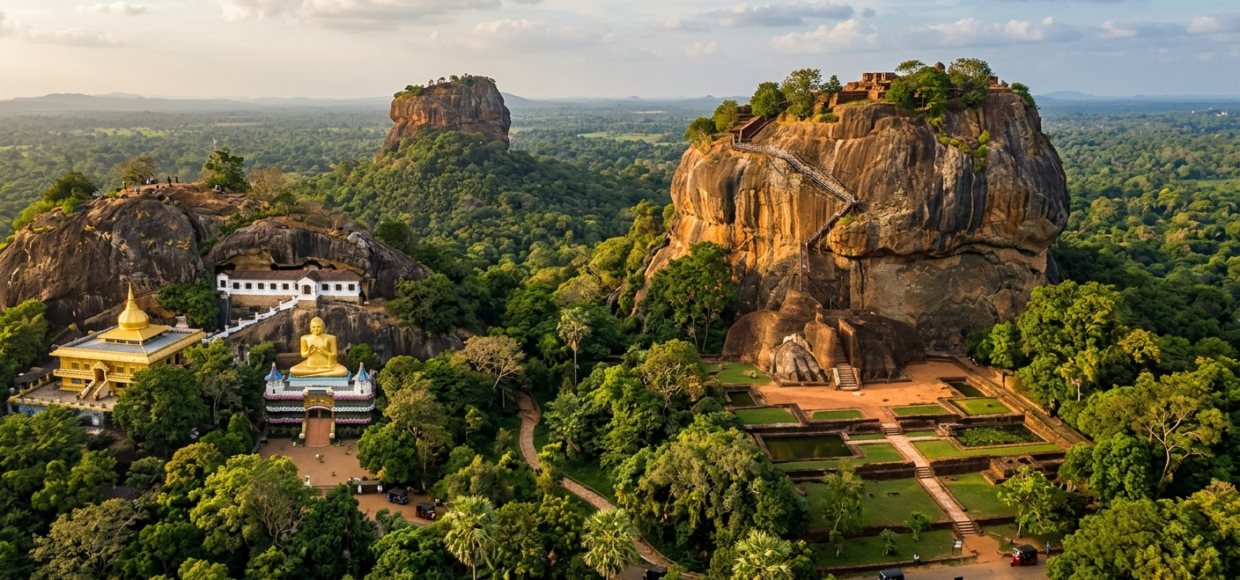
Lion Rock rises abruptly above the surrounding plain from its two hundred meters of dark granite. Toward the end of the fifth century, the dissident King Kashyapa chose this impressive promontory to establish his throne. This passionate and controversial sovereign built an imprenable fortified capital there. Nowadays, the preserved ruins still testify to the exceptional level of Sinhalese civilization.
🌳 Water gardens, stone gardens, and royal ramparts 💧
As soon as you cross the outer moats, you enter magnificent geometric gardens. The king’s engineers designed an extremely advanced hydraulic network. In the rainy season, the stone fountains still function thanks to natural pressure and gravity. Furthermore, the site integrates rock gardens and hanging terraces that embrace the contours of the boulders. Take time to stroll along the mirror ponds before heading toward the foot of the cliff.
🎨 The famous Maidens of Sigiriya and the Mirror Wall ✨
The climb begins with granite steps carved into the original structure. Then, a modern spiral staircase attached to the vertical wall leads you to a cavity sheltered from the elements. You discover there the famous wall paintings of the Maidens of Sigiriya. These elegant female figures with delicate features carry flowers and offerings. The original mineral and vegetable pigments retain an extraordinary brilliance despite fifteen centuries of existence. However, make sure to respect instructions: photos remain strictly prohibited in this zone to protect the artworks.
Continuing along the path, you walk beside the famous Mirror Wall. Workers of the era covered this parapet with a special plaster made of lime, egg whites, and beeswax. Once polished, the wall reflected light like a real glass. Pilgrims of past centuries carved delicate poems on the surface. These historic graffiti reveal the emotion of early visitors facing the beauty of the celestial palace.
🐾 The Lion Paws terrace and the summit plateau 👑
The route emerges onto a spacious intermediate esplanade. Two huge feline paws sculpted into the rock guard the true entrance to the royal residence. Formerly, a monumental lion head completed this impressive entryway. Visitors literally passed through the jaws of the beast to reach the top.
The last section takes place on secure yet dizzying metallic walkways. Once on the upper plateau of 1.5 hectares, the 360-degree landscape is striking. You gaze upon endless jungle, sparkling water reservoirs, and distant mountain lines. Furthermore, you observe the brick foundations of the king’s private apartments, reception halls, and the royal pool dug directly into the solid rock.
🏯 Dambulla Cave Temple: Sacred sanctuary in the rock 🪷
The Golden Temple of Dambulla constitutes the largest and best-preserved sacred cave complex in all of South Asia. Starting in the first century BCE, King Valagamba sought refuge in these cavities during a foreign invasion. Once restored to his throne in Anuradhapura, the grateful sovereign transformed these natural shelters into sumptuously decorated worship spaces. Subsequently, numerous dynasties restored and expanded the shrines.
🛕 Discovery of the five emblematic caves 🕯️
The site consists of five distinct caverns sheltered under a huge rocky overhang:
- Devaraja Lena (Cave of the Divine King): This first room is dominated by a gigantic fourteen-meter Reclining Buddha. Sculptors carved this effigy directly out of the mountain rock. At his feet stands his devoted disciple Ananda.
- Maharaja Lena (Cave of the Great Kings): This spectacular cavity impresses with its dimensions and artistic richness. It gathers fifty-six magnificent statues as well as an inner stupa. Moreover, sacred water constantly seeps from the ceiling and drips into a bronze vase without ever drying up.
- Maha Alut Vihara (The Great New Temple): Arranged in the eighteenth century under the reign of King Kirti Sri Rajasinha, this room presents fifty Buddha statues and wall paintings in a style typical of the Kandy era.
- Paccima Vihara (Western Cave): This smaller cavity shelters a small central dagoba and effigies in meditation posture. It emits a calm, intimate atmosphere.
- Devana Alut Vihara (The Second New Temple): The last, more recent cave contains Buddhist figures and several Hindu deities crafted with precision.
In total, more than two thousand square meters of colorful frescoes cover the mineral walls. They illustrate the temptations of the demon Mara, the sermons of Buddha, and founding scenes of Sri Lankan history. The soothing scent of incense and lotus flower offerings add an enchanting spiritual dimension.
🎫 Tickets, prices, and opening hours for 2026 🎟️
To prepare your travel budget accurately, here is the updated summary of entry prices and access times:
- Entry ticket for Sigiriya: The entrance fee for international visitors rises to 36 US dollars (around 11,000 Sri Lankan rupees). Ticket counters open daily from 6:30 AM to 5:30 PM. This ticket also includes access to the archaeological museum near the main parking area.
- Entry ticket for Dambulla: Entrance to the sacred caves costs 2,000 Sri Lankan rupees per adult. You must imperatively purchase your ticket at the counter at the base of the hill before starting the climb. The shrine welcomes visitors from 7:00 AM to 7:00 PM.
- Ticket for Pidurangala: Access to the neighboring rock costs 1,000 Sri Lankan rupees. The counter at the monastery near the trail start opens at 5:00 AM for sunrise hikers.
If you wish to enjoy comfortable transport with a driver and captivating explanations, you can book this 2-day guided tour to Sigiriya and Dambulla which handles all your activities and transfers.
🧗 Climbing Pidurangala: The perfect panorama of Sigiriya 🌅
Located just two kilometers north of Lion Rock, Pidurangala Rock offers an unmatched viewpoint. Historically, the monks residing at Sigiriya were relocated to this hill when King Kashyapa began building his palace. The picturesque trail winds through dense forest, passing an ancient monastery and walking beside a large restored Reclining Buddha.
The end of the hike requires scrambling over a few large granite boulders. Nevertheless, this moderate physical effort is amply rewarded as soon as you reach the flat summit. The circular panorama embraces the whole region, with an unimpeded frontal view of the imposing silhouette of Sigiriya. We highly recommend making this climb early in the morning to watch the first light of dawn rise over the canopy.
🗺️ Recommended 2-day itinerary in the Cultural Triangle 🗓️
To visit these wonders without rushing and fully enjoy the local ambience, we suggest following this optimized two-day itinerary:
- Day 1: Dawn at Pidurangala and Dambulla spirituality
- 5:00 AM: Early departure and climb of Pidurangala Rock to admire the sunrise.
- 8:30 AM: Traditional Sri Lankan breakfast at a local village cafe.
- 11:00 AM: Check-in at your hotel and refreshing break by the pool.
- 3:00 PM: Drive to Dambulla and guided visit of the five sacred caves in the soft late afternoon light.
- 7:30 PM: Flavorful dinner of traditional curry in the city center.
- Day 2: The citadel of Sigiriya and rural immersion
- 6:30 AM: Arrival at site opening for Sigiriya to beat the heat and crowds.
- 10:00 AM: Detailed visit to the archaeological museum to understand the scale model and artifacts found on site.
- 12:30 PM: Rice and curry lunch at an eco-friendly restaurant surrounded by paddy fields.
- 3:30 PM: Jeep safari in Minneriya or Kaudulla National Park to observe herds of wild elephants.
🏨 Where to stay in Sigiriya and Dambulla: Selection of top hotels 🛏️
Your choice of accommodation depends primarily on the style of stay you seek. Sigiriya favors immersive eco-lodges and immediate proximity to nature. On its end, Dambulla offers very practical hotel structures located at the junction of the island’s major roads. Here is our selection of trusted establishments:
- Luxury hotel and integrated architecture: Heritance Kandalama. Designed by master architect Geoffrey Bawa, this iconic hotel literally blends into the rock and vegetation along Lake Kandalama. Its infinity pools and panoramic views guarantee a magical stay.
- Direct view of Lion Rock: Hotel Sigiriya. This famous establishment benefits from an unbeatable location. Its large outdoor pool directly overlooks the majestic monolith, offering an idyllic setting after a day of hiking.
- Intimate charm and tropical garden: il Frangipane. Nestled in the lush greenery of Sigiriya, this human-scale hotel offers elegant rooms, attentive service, and a peaceful atmosphere.
- Haven of peace by the water: Jetwing Lake. Set beside a calm lake in Dambulla, this establishment combines modern design, eco-friendly practices, and top-tier comfort.
🛵 How to move between Sigiriya and Dambulla? 🛺
You have several very simple options to travel between the two cities according to your budget and desire for autonomy:
First, the tuk-tuk remains the king vehicle for getting around Sri Lankan roads. Local drivers offer single trips or day packages. Expect between 2,500 and 4,000 rupees for a round trip with waiting time at the different sites. It is a flexible, picturesque method to discover rural landscapes.
Next, public buses regularly connect the Dambulla bus station to the center of Sigiriya. Departures take place roughly every thirty minutes between 6:30 AM and 6:00 PM. The trip costs under 100 rupees per person. Although slower, this immersive transport offers an authentic experience connecting with locals.
Finally, renting a scooter or bicycle turns out ideal for independent travelers. The roads linking both towns are generally in good condition and not very steep. Nevertheless, be particularly vigilant at the end of the day: wild elephants sometimes emerge from nearby reserves to cross roadways after nightfall.
🎒 Essential items in your backpack 🧳
To explore the archaeological sites of the Cultural Triangle under optimal conditions, make sure to bring the following items:
- An insulated reusable water bottle to stay well hydrated throughout the day.
- Lightweight walking shoes with good grip to climb slippery steps.
- Covering clothing (sarong, scarf, or light trousers) to respect temple dress codes.
- A pair of thick socks to walk across the sun-baked rock of Dambulla without burning your feet.
- High-protection sunscreen, sunglasses, and a wide-brimmed hat.
- An effective mosquito repellent suited for tropical areas during evening walks.
🍛 Where to eat: Discovering local gastronomy 🥥
Exploring ruins builds up an appetite. Fortunately, the region abounds with small family restaurants called “Roti Shops” or “Curry Houses.” This is the ideal opportunity to savor real Sri Lankan rice and curry. Cooks serve you a large bowl of steamed rice accompanied by a multitude of side dishes: red lentil dhal curry, tender jackfruit curry, caramelized eggplant, and freshly grated coconut sambol.
During your strolls, quench your thirst with the sweet juice of a King Coconut, chopped open before your eyes by street vendors. In the evening, let yourself be tempted by a flavorful kottu roti. The popular dish par excellence, it consists of shredded flatbread, crunchy vegetables, eggs, and spices stir-fried at high speed on a cast-iron griddle.
🎒 My personal experience: An intense day between rock and devotion ✍️
My alarm rang at 4:30 AM. In the cool darkness of Sigiriya village, I joined the base of Pidurangala Rock. Equipped with a headlamp, I climbed the forest trail to the rhythm of nocturnal jungle sounds. The final meters scrambling between large granite boulders required some attention. However, the reward at the top exceeded all my expectations. As the sun pierced the horizon, the morning mist gently dissipated to reveal the majestic silhouette of Lion Rock. That moment of pure contemplation remains engraved in my memory.
By 7:30 AM, I hiked down to begin visiting Sigiriya without delay. Starting so early allowed me to climb the metal walkways in relative quiet, watching monkeys play in the canopy. Upon reaching the royal platform, the morning breeze refreshed the air. One truly realizes the extraordinary technical feat represented by building such a palace in the fifth century.
In the afternoon, I took to the road toward Dambulla Caves. The oppressive midday heat vanished immediately as I stepped into the first cavity. Walking barefoot on the cool ground while admiring candle light illuminating the serene faces of Buddhas brought me a feeling of absolute serenity. These two complementary visits offered me a perfect snapshot of Sri Lankan cultural wealth.
❓ Frequently asked questions: Everything to know to visit Sigiriya and Dambulla 💡
🤔 How much time should you dedicate to visiting both sites? ⏱️
We recommend dedicating a minimum of one full day to discover the two major sites. Spend about three hours in the morning visiting Sigiriya, its gardens, and its archaeological museum. In the afternoon, plan two hours to explore the five caves of Dambulla. If you wish to add the climb of Pidurangala and a safari, plan for two full days on site instead.
👟 What dress code should you adopt at Dambulla? 👗
Dambulla is a Buddhist place of worship heavily frequented by pilgrims. You must imperatively wear decent clothing covering your shoulders and knees (valid for both women and men). Additionally, you must remove shoes and headwear before entering the esplanade of the caves. Consider bringing socks because the rock slab becomes very hot under the sun.
🐒 How to behave around monkeys on the sites? 🍌
Toque macaques and langurs are very numerous around the rocks. Although accustomed to human presence, they remain unpredictable wild animals. Do not hold food or sugary drinks in hand. Keep your backpack zippers closed tightly. Finally, avoid staring into their eyes or trying to touch them.
👶 Is the climb of Sigiriya suitable for children and seniors? 👨👩👧
The climb involves approximately 1,200 steps. It presents no specific technical difficulty but requires normal physical condition. Walking-age children complete the ascent very easily by taking regular breaks. People subject to intense vertigo might nevertheless feel apprehension on the metal walkways attached to the cliff.
🌤️ What is the ideal period to visit this region of Sri Lanka? ☀️
The best period to visit the Cultural Triangle stretches from January to April, as well as during July, August, and September. During these weather windows, conditions remain mostly dry and sunny. The November and December period corresponds to the northeast monsoon, bringing more frequent rains.
📸 Is photography permitted inside the monuments? 📷
Photography is permitted across the vast majority of the sites. However, two strict rules apply: photographing the frescoes of the Maidens of Sigiriya is totally prohibited. Furthermore, inside Dambulla Temple, you must never pose turning your back to Buddha statues, as this is considered a serious lack of respect toward the religion.
✨ Final tips for a successful discovery 🇱🇰
To ensure your journey to the heart of Sri Lanka remains a memorable memory, organize your stops avoiding the hottest hours of the day. Prioritize visits during the first light of morning or late afternoon. Do not hesitate to meet local residents, known for their legendary kindness. By combining the natural beauty of Sigiriya and the spiritual depth of Dambulla, you will discover the true soul of this splendid island.