


On the shore of Kandy Lake, the Temple of the Tooth (Sri Dalada Maligawa) houses Sri Lanka’s most revered relic: a tooth of the Buddha. For centuries, whoever held it held the right to rule the island.
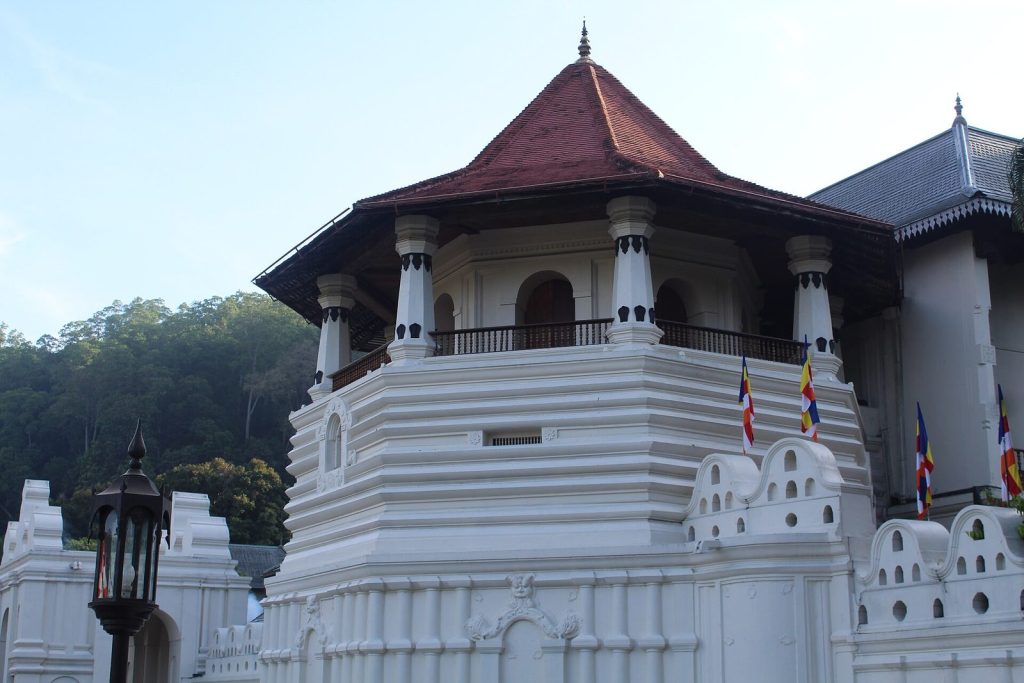
The temple stands within the grounds of the former royal palace, at the heart of a UNESCO World Heritage city. Its tiled roofs, octagonal pavilion and moat decorated with cloud motifs form an elegant whole, typical of Kandyan architecture. The relic itself is never shown: it rests inside a series of nested gold caskets, which the faithful contemplate from afar, amid fervour and the scent of flowers.
The Temple of the Tooth is much more than a monument: it is a complex of shrines, royal audience halls, museums and courtyards opening onto the lake, listed as a UNESCO World Heritage Site together with the sacred city of Kandy. To make the most of it, you need to know the ceremony times, the required dress and the route through the visit, which can quickly feel confusing on the day you arrive.
The visit is not limited to the main shrine. Around the central courtyard, several buildings deserve a closer look: the great audience hall with its carved wooden pillars, where kings received their ministers, the museum devoted to the relic and its history, and the International Buddhist Museum, which shows how the religion spread across Asia. In the evening, when the oil lamps are lit and crowds of worshippers press in front of the altar, the atmosphere becomes almost unreal. Tourists mingle with Sri Lankan families who have come to pray, monks in saffron robes and schoolchildren in white uniforms. Even if you are not a Buddhist, you can feel the fervour of this place, considered the most sacred in the country. A visit to the Sri Dalada Maligawa is therefore much more than a cultural stop: it is an immersion in the spiritual heart of Sri Lanka.
The visit is best planned around a puja. Arrive a little before the ceremony to leave your shoes, buy a few flowers at the entrance and go through the security checks. Then follow the flow of worshippers upstairs, where the door of the shrine is. When the drums sound, the doors open for a few minutes and the crowd moves forward slowly. After the ceremony, explore the side halls and museums at your own pace, then finish with a stroll along Kandy Lake, when the town lights up and locals come out to walk around the water. This way you experience the Temple of the Tooth in both its monumental and spiritual dimensions, without missing anything essential. Wear white or light-coloured clothing covering shoulders and knees: it is the traditional colour of worshippers and a sign of respect that is appreciated.
Every day, thousands of worshippers dressed in white come to lay lotus flowers to the sound of drums. Attending a puja, the offering ceremony, is a highlight of any trip. Here is how to prepare your visit.
🧳 My personal experience
I have been to the Temple of the Tooth many times, as I often pass through Kandy. The first time, I tried to go in wearing shorts: I was turned away at the entrance. You must cover your shoulders and knees, and you can buy or rent a sarong right next door. The ticket for foreigners is around 2,000 rupees, plus a small fee for the shoe storage.
My main tip is about timing. I attended the evening puja, around 6:30 pm: it is the busiest. You wait in a tight queue upstairs, move forward a few at a time, and the shrine door only stays open for a few minutes. If you hope to see the relic, you will be disappointed: you only glimpse the golden casket from a distance, and you have to accept being pushed a little.
These days I prefer the dawn puja, around 5:30 am. It is mostly locals, the atmosphere is calmer and you can stay longer. After the ceremony, I took time to visit the side halls and the museum, which many visitors skip. Allow an hour and a half in total.
Practical points: the stone floor is cold in the morning and scorching at midday, so socks help. Security checks are strict, with bag searches. Finally, don’t linger in front of the main entrance: that is where touts offer guided tours or dance shows on commission.
My verdict: about 2,000 rupees entry, a little change for the shoes, an hour and a half’s visit. Best time in my view: the dawn ceremony. Bring: covering clothes, socks, a light bag for the search. Avoid: offers of guides or shows made by strangers in front of the entrance.
📋 Key facts at a glance
| 📍 Location | Central Kandy, on the lakeshore |
| 💶 Price | About 2,000 rupees (≈ €6) for foreigners |
| ⏱️ Visit length | 1.5 to 2 hours |
| 🥾 Difficulty | ⭐⭐⭐⭐⭐ Easy, right in the town centre |
| ⏰ Best time | During a puja, in the morning or evening |
| 👕 Dress code | Shoulders and knees covered, ideally in white |
📍 Where is the Temple of the Tooth?
The temple lies at the heart of Kandy, the former royal capital nestled in the hills, about 3 hours from Colombo. It is part of the “Sacred City of Kandy”, a UNESCO World Heritage Site.
- 1Lac de Kandy · à côté
- 2Bouddha de Bahirawakanda · ≈ 2 km
- 3Gare de Kandy · ≈ 1 km
- 4Forêt d'Udawattakele · ≈ 1 km
- 5Jardin de Peradeniya · ≈ 6 km
🏛️ The history of the relic
According to tradition, the tooth was recovered from the Buddha’s funeral pyre, then brought from India to Sri Lanka in the 4th century, hidden in a princess’s hair. It then followed the Sinhalese kings from capital to capital, from Anuradhapura to Polonnaruwa, before reaching Kandy.
The present temple was built in the 17th and 18th centuries by the kings of Kandy; the octagonal pavilion overlooking the lake was added by the last king. Damaged by a bombing in 1998, the temple has been restored and remains the spiritual heart of the country.
👀 What to see in the temple
- The relic shrine: the tooth rests in a golden casket, whose chamber opens during the pujas.
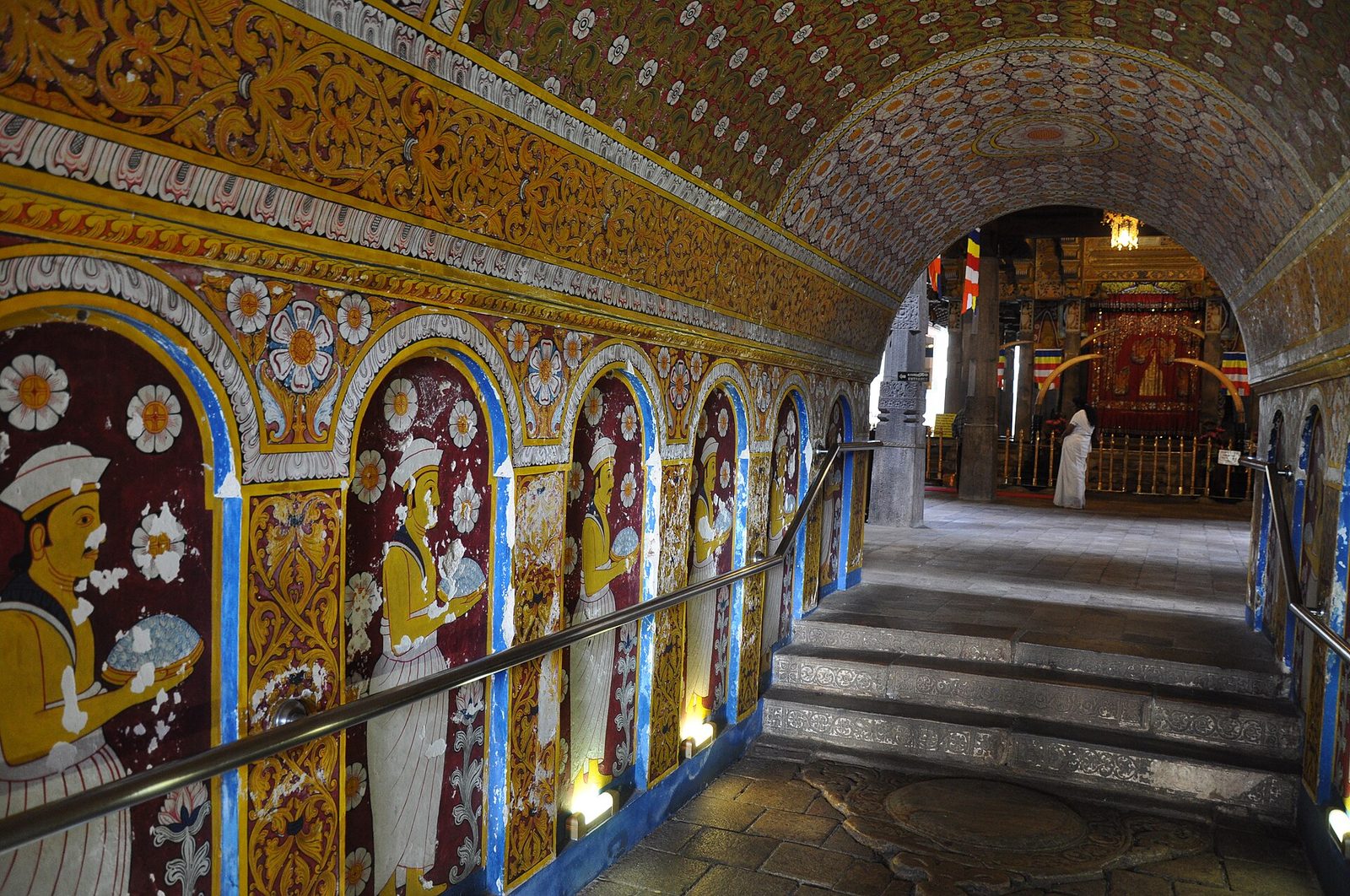
- The painted corridors: frescoes and decorations in vivid colours.
- The octagonal pavilion (Pattirippuwa), reflected in the lake.
- The World Buddhism Museum and the temple museum, included in the visit.
- Raja’s hall: the stuffed elephant that carried the relic for decades during the Esala Perahera.
🚶 How to get to the Temple of the Tooth
➡️ From Kandy railway station
About 15 minutes on foot through the town centre, or a few minutes by tuk-tuk.
➡️ From Colombo
The train links Colombo Fort to Kandy in 2.5 to 3 hours; by car, allow about 3 hours.
➡️ From Sigiriya
About 2.5 to 3 hours by road via Dambulla and Matale.
➡️ On site
The temple is within walking distance of the lake and the shopping streets of the centre.
💶 Prices and opening hours
- Ticket: about 2,000 rupees (≈ €6) for foreign visitors, free for worshippers.
- Pujas: three ceremonies a day, at dawn, mid-morning and in the evening (approximate times: around 5:30 am, 9:30 am and 6:30 pm).
- Shoe storage: a small fee is charged at the entrance.
- Opening hours: the temple is open from early morning to evening; crowds are largest during pujas and on full-moon days.
🥾 Difficulty and accessibility
The visit is easy: the temple is mostly on one level, with a few staircases. You visit barefoot. The site can be very busy during pujas and on Poya (full-moon) days.
⏰ When to go?
- During the evening puja: the atmosphere is at its most impressive.
- Early in the morning: for a quieter visit, before the groups arrive.
- In July or August: the Esala Perahera, the great elephant procession, enlivens Kandy for about ten nights.
- All year round: the temple can be visited in any season.
💡 Our tips
- Dress in white or light colours, with shoulders and knees covered; a sarong can be lent or bought on site.
- Bring socks: the stone floor can be cold or hot.
- Buy a few lotus flowers at the entrance to offer, as the worshippers do.
- Never turn your back on a Buddha statue for a photo.
- Keep silent during ceremonies and don’t use flash photography.
🛏️ Where to stay in Kandy
Kandy has hotels for every budget, often with views of the lake or the hills.
🏨 Guesthouses autour du lac de Kandy
📍 Kandy · Budget · 💶 15 – 35 € / night
Homestay rooms on the heights, with views over the town, 15 minutes’ walk from the temple.
🏨 Queen’s Hotel
📍 Kandy · Mid-range · 💶 50 – 90 € / night
A colonial hotel steeped in history, right opposite the temple: you couldn’t be better placed.
🏨 Earl’s Regency
📍 Kandy · Luxury · 💶 100 – 170 € / night
A large hotel on the banks of the Mahaweli River, with a lovely pool, 15 minutes from the centre.
🧭 What to do nearby?
The temple is the ideal starting point for exploring Kandy and its surroundings:
- Kandy Lake (next door): a walk of about an hour, in peace and quiet. Our Kandy guide
- The Bahirawakanda Buddha (≈ 2 km): the best view over the town. Our Kandy guide
- Peradeniya Botanical Garden (≈ 6 km): one of the finest botanical gardens in Asia. Our Kandy guide
- Kandyan dancing (in town): a show every evening, with fire-walking. Our Kandy guide
- The Nuwara Eliya plantations (≈ 2.5 h): tea country and its factories. Discover Nuwara Eliya
- The train to Ella (6 to 7 h): the most beautiful rail journey in the country. Our article on trains
🗺️ In our itineraries
Kandy and the Temple of the Tooth feature in all our itineraries:
🔗 Useful links
- Sri Dalada Maligawa: the official website of the Temple of the Tooth.
- Sacred City of Kandy: the site’s page on the UNESCO portal.
- Sri Lanka Tourism: the official website of the Sri Lanka tourist board.
❓ Frequently asked questions
Can you see the Buddha’s tooth?
No, the relic rests in a golden casket. During the pujas, the chamber opens and you can glimpse the casket.
What should you wear?
Clothes covering shoulders and knees, ideally light-coloured. You visit barefoot.
What time can you attend a puja?
There are three pujas a day, at dawn, mid-morning and in the evening. Check on site, as times may vary.
When is the Esala Perahera?
In July or August depending on the lunar calendar, for about ten nights before the full moon.