


🚂 Getting around Sri Lanka
Getting around Sri Lanka: train, bus, tuk-tuk, taxi, Uber and PickMe, car with driver, domestic flights, travel times and prices to plan your trip.
🚂 Getting around Sri Lanka: how to travel easily during your trip
Discovering Sri Lanka means exploring an island of exceptional landscapes, from tropical beaches and tea plantations to lush mountains, ancient temples and national parks. But to make the most of all this, you also need to choose the right ways of getting around.
Even though Sri Lanka is relatively small, getting around can take a long time. Roads are sometimes narrow, traffic is heavy in the big cities and mountain routes are particularly winding. A journey of a few dozen kilometres can therefore take several hours.
Fortunately, the country offers plenty of ways to get around: scenic trains, local buses, tuk-tuks, taxis, cars with drivers and even a few domestic flights.
What is the best way to get around Sri Lanka? It all depends on your budget, the length of your stay and the regions you want to explore. For a first trip, the ideal is often to combine several options: a car with driver for long distances, the train to enjoy the scenery and the tuk-tuk for short hops.
Read our complete guide to understand transport in Sri Lanka, compare the different options and organise your journeys in the best possible conditions.
🚆 The train in Sri Lanka: a must
The train is one of the most iconic ways of getting around Sri Lanka. The rail network links Colombo to the country’s main towns and crosses some of the island’s most spectacular scenery.
Travelling by train lets you discover the country at a different pace. You pass tea plantations, traditional villages, tropical forests and mountain valleys. Some lines offer such exceptional views that the journey becomes an attraction in itself.
🚂 The famous train from Kandy to Ella
The rail journey between Kandy and Ella is probably the most famous in the country. The line crosses the central highlands and the great tea plantations that made Sri Lanka’s name.
The route offers magnificent scenery, with historic bridges, tunnels, waterfalls and villages clinging to the hillsides.
One of the best-known sections is the Nine Arch Bridge, an impressive viaduct near Ella. Surrounded by lush tropical vegetation, this stone bridge attracts many visitors.
The full journey can take several hours and timetables vary according to the services available.
Our tips for travelling by train:
- Book seats in advance on the busiest tourist lines.
- Choose a window seat to enjoy the scenery.
- Bring water and some snacks for long journeys.
- Get to the station early enough to find your platform and carriage.
- Keep your luggage and valuables close to you.
Please note: rail services can be interrupted by engineering works, landslides or bad weather. Always check timetables and possible disruptions before you set off.
🎟️ The different train classes
Sri Lankan trains offer several classes of seats, with different levels of comfort and booking arrangements.
First class: usually more comfortable, with reserved seats and, on some services, air conditioning. A good option for travellers who want to make a long journey in good conditions.
Second class: often a good compromise between comfort and budget. Some trains offer reserved seats, while others only sell unreserved tickets.
Third class: the cheapest option. Carriages can be very crowded and seats are not always guaranteed. It does, however, offer a very local rail experience.
Where to book tickets? For reserved seats, use the official Sri Lanka Railways booking portal: https://seatreservation.railway.gov.lk/
🚌 The bus in Sri Lanka: the cheapest way to travel
Sri Lanka’s bus network covers most of the country. It is one of the cheapest ways to reach towns, villages and many tourist destinations.
Two main types of operator run the services: the public Sri Lanka Transport Board (SLTB) and private companies.
The red public buses are easy to recognise. Private buses run many routes, sometimes with air-conditioned vehicles and express services.
🚍 Public buses
Public buses serve many destinations, including small towns far from the main tourist routes.
They have several advantages:
- Fares are generally very affordable.
- An extensive network across the whole country.
- Many connections between towns.
- An authentic experience alongside local people.
On the other hand, comfort can be limited. Buses can be packed, especially at rush hour, and some drivers drive fast.
Timetables can also vary depending on the route and traffic conditions.
❄️ Private and air-conditioned buses
Private companies run many intercity routes. Some offer air-conditioned vehicles and more comfortable seats.
Express buses are a good way to reach some of the big cities, especially thanks to the expressways linking Colombo to the south of the country.
For travellers on a tight budget, buses are an excellent alternative to taxis or private cars.
Our tip: avoid long bus journeys at peak times if you are travelling with a lot of luggage. For major journeys, choose an express service or private transport.
🛺 The tuk-tuk in Sri Lanka: the iconic way to get around
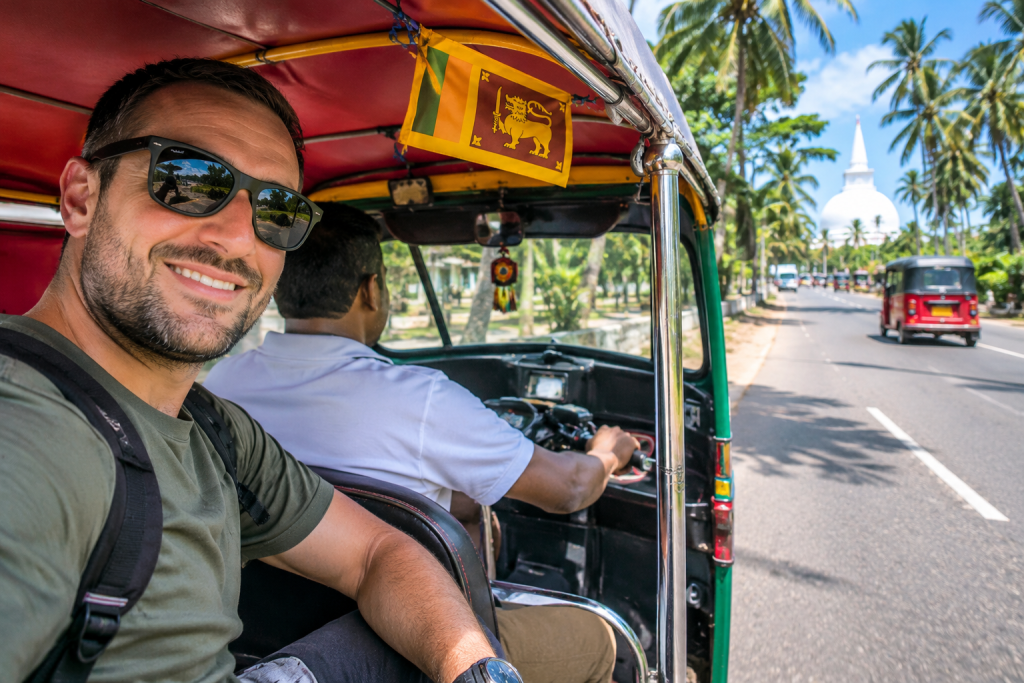
You can’t visit Sri Lanka without coming across the famous tuk-tuks. These small three-wheelers are part of the urban and rural landscape.
They drive around the streets of Colombo, villages, beach resorts and tourist areas. Their small size lets them weave easily through traffic.
Tuk-tuks are particularly suited to short journeys, trips to restaurants, local sightseeing and rides between your accommodation and tourist sites.
💰 How much does a tuk-tuk ride cost?
The fare mainly depends on the distance, the town, demand and the type of vehicle.
Some tuk-tuks have a meter, while others charge a price negotiated directly with the driver.
In Colombo and the big cities, booking apps also let you see the price before confirming a ride.
To avoid unpleasant surprises, always ask the price before getting into a tuk-tuk without a meter.
📱 Can you rent a tuk-tuk for several days?
Yes. You can rent a tuk-tuk for several days to explore some regions independently.
This appeals to travellers who want an unusual experience and to explore the back roads at their own pace.
However, driving a tuk-tuk takes some getting used to. Traffic can be heavy, the rules of the road differ from those European drivers know and the roads are sometimes difficult.
You also need the appropriate driving permits and should check the rental company’s insurance conditions.
Our tip: for a first trip to Sri Lanka, use tuk-tuks with a driver for short journeys. Self-drive rental is better suited to experienced travellers.
🚕 Taxis in Sri Lanka: comfort and simplicity
Taxis are a practical way to get around quickly, especially in the big cities and between the main tourist sites.
Several types of vehicle are available: small cars, saloons, family cars and minibuses.
Taxis are particularly suitable for airport transfers, travelling with children or journeys where you want more comfort.
📲 Uber and PickMe: booking a taxi on your phone
Two apps are particularly useful for getting around Sri Lanka:
Uber: the international app lets you order a car or, in some areas, a tuk-tuk. It usually shows the estimated price before you book.
PickMe: this Sri Lankan app is a good alternative. It offers cars and tuk-tuks in the areas covered by its network.
These services make booking easier and limit price haggling with drivers.
Note, however, that vehicle availability varies from town to town. In rural regions or remote tourist areas, the apps may have few drivers.
Practical tip: install the apps before you leave, create your account and check that your payment method works abroad. A local SIM card or mobile data will make booking much easier.
🚗 Renting a car in Sri Lanka: with or without a driver?
Renting a car is a good way to explore several regions without depending on public transport timetables.
There are two options, however: renting a car with a driver or driving yourself.
👨✈️ Car with driver: a very popular option with tourists
Many travellers choose to hire a car with a driver to organise their tour of Sri Lanka.
This option has several advantages:
- Comfortable, air-conditioned transport.
- Plenty of freedom in choosing your stops.
- Long journeys are easier to manage.
- You can stop to visit places along the way.
- A driver who knows the roads and local ways.
Some drivers also know the tourist sites well and can share information about the culture, traditions and regions you pass through.
Before booking, ask for a detailed quote specifying the number of days, any mileage, fuel, tolls, the driver’s expenses, meals and accommodation.
Our tip: for a 10 to 15-day tour, a car with driver is often one of the most comfortable options, especially if you are travelling as a family or in a group.
🚘 Driving yourself in Sri Lanka
Renting a car without a driver gives you more independence, but it requires good preparation.
In Sri Lanka, traffic drives on the left, as in the United Kingdom. Drivers also have to contend with buses, tuk-tuks, motorbikes, pedestrians and sometimes animals crossing the road.
In some mountainous regions, roads are narrow, winding and sometimes difficult.
To drive legally, your national licence alone is not necessarily enough. Travellers must obtain the documents and permits recognised by the Sri Lankan authorities, in particular an international driving permit together with the required local recognition or authorisation.
Check with the rental company and the relevant authorities before you leave.
A few essential precautions:
- Check the insurance conditions and exclusions in the contract.
- Check the condition of the vehicle before setting off.
- Avoid driving at night as much as possible.
- Respect speed limits and road signs.
- Be extra careful in towns and mountain areas.
✈️ Flying in Sri Lanka: saving time over long distances
Domestic air travel exists in Sri Lanka, although it is less developed than the road and rail networks.
Specialist operators offer private flights, air transfers and sometimes seaplane services to certain tourist destinations.
These services can considerably reduce travel times between some regions.
They are mainly aimed at travellers with a larger budget, groups and those who prioritise comfort.
There are several things to bear in mind, however:
- A limited number of destinations and flights.
- Fares generally higher than land transport.
- Availability depends on the season and operators.
- Weather conditions can change schedules.
For a standard two-week trip, domestic flights are generally not essential. The train and a car with driver already let you see a large part of the country.
🚲 Cycling and walking: another way to discover Sri Lanka
Cycling is a pleasant way to discover some regions of Sri Lanka, especially rural areas and historic sites.
Around Polonnaruwa, Anuradhapura and in parts of the Cultural Triangle, tracks and roads let you explore the countryside at a relaxed pace.
Several hotels and guesthouses rent out bicycles, sometimes included in the price.
Walking is also an excellent way to discover tea plantations, villages and natural sites.
Bear in mind the heat, humidity and traffic, however. Cycle early in the morning and avoid main roads when traffic is heavy.
🛬 How to get to Colombo from Sri Lanka’s international airport
Most international travellers arrive at Bandaranaike International Airport, near Negombo, north of Colombo.
There are several ways to reach the capital or your accommodation.
Taxi: the simplest option after a long flight. Taxis are available at the airport and transfers can also be booked in advance.
Uber and PickMe: these apps may let you order a car, depending on driver availability around the airport.
Bus: public services and express routes go to some destinations, including Colombo. Check departure points and timetables before you travel.
Car with driver: this option is particularly suitable for travellers who want to go straight to their hotel or start their tour as soon as they arrive.
Our tip: if your flight lands late in the evening, arrange your transfer in advance. That way you won’t have to look for transport after many hours of flying.
⏱️ How much time should you allow for the main journeys in Sri Lanka?
One of the most common mistakes when planning a trip is underestimating travel times.
Distances may look short on a map, but traffic, winding roads and driving through towns slow journeys down considerably.
Here are some rough estimates to help you plan your itinerary by car.
| Journey | Approximate time |
|---|---|
| Airport – Colombo | 1 h to 1 h 30 |
| Colombo – Kandy | 3 h to 4 h |
| Colombo – Galle | 2 h to 3 h |
| Colombo – Sigiriya | 4 h to 5 h |
| Kandy – Nuwara Eliya | 2 h 30 to 3 h 30 |
| Nuwara Eliya – Ella | 2 h to 3 h |
| Ella – Mirissa | 4 h to 5 h |
| Galle – Mirissa | 1 h to 1 h 30 |
These times are planning estimates and may vary depending on the route, traffic, roadworks and weather. They are not guaranteed timetables.
Tip: avoid planning several long road stages on the same day. Sri Lanka is also discovered on the move: take time to enjoy the scenery and stop along the way.
⚠️ Safety and precautions when travelling in Sri Lanka
Getting around Sri Lanka requires a few precautions, especially for travellers new to local driving.
Traffic can be daunting in the big cities. Overtaking, sudden turns and the presence of many types of vehicle at once require constant vigilance.
Here are the main recommendations:
- Driving on the left: remember that vehicles drive on the left and the steering wheel is usually on the right.
- Animals on the roads: watch out for dogs, cows and other animals that may cross without warning.
- Night travel: avoid long journeys after dark, especially on rural roads.
- Buses: choose reputable operators and keep an eye on traffic conditions.
- Luggage: keep your valuables with you, especially on crowded transport.
- Train: never lean out of the doors or windows while the train is moving.
- Weather: during the monsoons, some roads can be flooded or hit by landslides.
For official information and safety advice, check your government’s travel advice before you leave.
💰 Which transport to choose for your budget?
Transport can account for a large share of the overall cost of a stay in Sri Lanka. Fortunately, there are options to suit almost every situation.
| Transport | Budget | Ideal for |
|---|---|---|
| Public bus | Very cheap | Tight budgets |
| Train | Cheap | Scenic journeys |
| Tuk-tuk | Depends on distance | Short trips |
| Taxi / ride-hailing | Mid-range to high | Comfortable journeys |
| Car with driver | Higher | Sightseeing tours |
| Domestic flight | High | Long distances |
| Bicycle | Cheap | Exploring locally |
To keep your budget under control, the ideal is to combine public transport with a few private journeys. That way you can enjoy comfort when you need it without overspending.
❓ FAQ: frequently asked questions about getting around Sri Lanka
What is the best way to get around Sri Lanka?
For a first trip, a car with driver is a particularly practical option. It makes it easy to reach the main tourist sites. It is also worth taking the train to see the mountain scenery and using tuk-tuks for short trips.
Is it easy to get around Sri Lanka without a car?
Yes. The bus and train networks reach many destinations. Tuk-tuks and taxis complete these services for local trips. You just need to allow more time and plan your connections.
Is the train safe in Sri Lanka?
The train is widely used by both locals and tourists. You should nevertheless follow the safety instructions, stay inside the carriages during the journey and keep an eye on your belongings.
Should you book train tickets in advance?
For popular tourist journeys, especially in the mountains, it is best to book seats as early as possible. Unreserved tickets are usually subject to availability on the day of travel.
Can you use Uber in Sri Lanka?
Yes, Uber operates in several parts of the country, especially in the big cities. PickMe is also a good local alternative. Availability depends on where you are, though.
Can you rent a tuk-tuk in Sri Lanka?
Yes, several companies rent out tuk-tuks. However, you need to check the insurance conditions, the required documents and the local permits for driving this type of vehicle.
Is it better to hire a car with a driver?
For families, groups and travellers who want to see several regions in a short time, this option has many advantages. In particular, it avoids the challenges of driving locally.
Can you get to the beaches by train?
Yes. The coastal line serves several towns in the south and west, including Galle, Matara and the places in between. The trains offer lovely views over the Indian Ocean.
🌴 Conclusion: how to organise your travel in Sri Lanka
Sri Lanka offers a wide range of transport options that let you discover the country according to your wishes and budget.
The train remains a must for admiring the mountain scenery, the bus is a cheap option for long distances, and the tuk-tuk makes everyday trips easy. Taxis and cars with drivers add comfort and flexibility.
To make the most of your stay, we recommend not limiting yourself to a single means of transport. Combine the different options according to your itinerary and the time you have.
Finally, remember that getting around is an integral part of the Sri Lankan experience. Between palm-lined roads, tea plantations and traditional villages, the journey often begins long before you reach your destination!